Manufacturers hold onto their manufacturing ERP systems for eight to twelve years on average — and some keep running them long after the software has reached its end of life and is no longer supported by the ERP vendor.
If you think about the cellphone that you were carrying twelve years ago versus the one you use today, it’s safe to say that more than few advances and refinements have been made over the last decade. For manufacturers, there are real costs to continuing to rely on legacy accounting and ERP software, including drained operational efficiency, slow or ill-informed decision making, and barriers to growth.
The reasons manufacturers are reluctant to change are understandable. As NexTec’s CEO Brian Howell puts it, “ERP implementations are notoriously complex and can be disruptive without an experienced partner to guide the transition. To ensure long-term value and ROI, it is essential to partner with a consulting firm that is committed to your success not only during the sales cycle and initial implementation, but throughout the entire lifecycle of the ERP software.”
Over your career in manufacturing, you may have heard, or experienced firsthand, how an ERP project can go sideways. Budgets balloon, timelines slip, teams disengage. The system goes live, but nobody uses or trusts it. In our experience working with manufacturing clients, all of these pitfalls are avoidable with careful planning and the right ERP implementation partner in your corner.
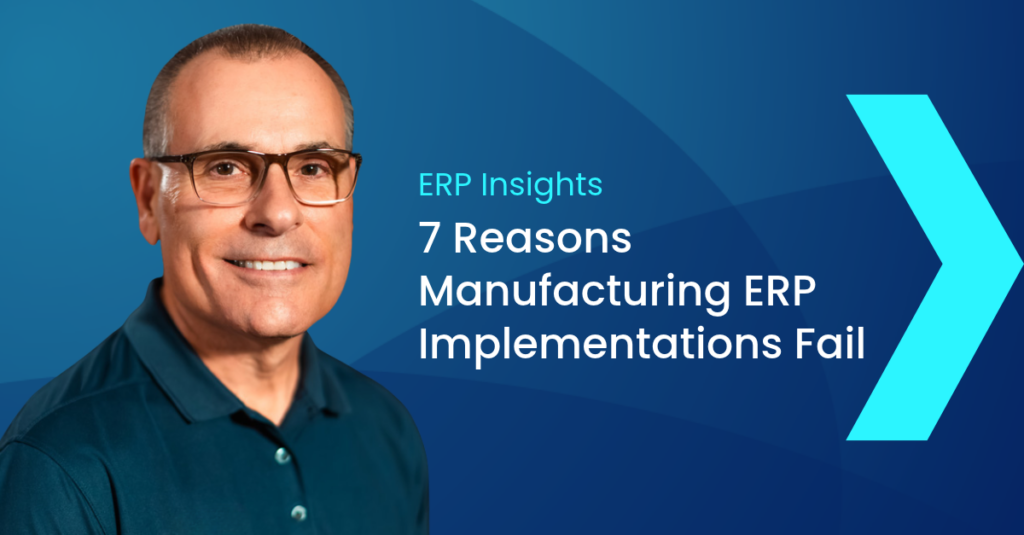
In this article, Jim Gross, Client Account Manager at NexTec, and a former manufacturing company CFO himself, shares seven common reasons manufacturing ERP implementations fail and how you can avoid them.
1. Choosing a Manufacturing ERP Partner Without Vetting Their Experience
Too many manufacturers select an ERP implementation partner based on price or a slick demo without doing their homework on the team who will be doing the work.
“The biggest question that you have to ask is what’s the experience of the team that you’re going to be working with,” says Gross. “Do they have experience in your specific industry niche, and have they got the client references to back it up? Do they understand your business? Do they speak your language?”
Ask specifically who will manage your project. At NexTec, that means senior-level consultants running implementations directly, a clearly defined six-step implementation methodology, and weekly updates from discovery through go-live — not a rotating cast of junior staff learning on your dime, or a single, self-employed consultant sitting in a home office somewhere with no development or support resources behind them.
2. Treating a Version Upgrade as Modernization
One of the most common — and costly — mistakes manufacturers make is assuming a straightforward system upgrade will solve the underlying problems with their ageing accounting software.
Before committing to an upgrade path with your existing software, be honest about whether the platform can support where your business is headed — or whether it’s time for a more fundamental change.
“If you’re on a 2010-era platform, even if you upgrade to the latest version, it’s still going to be basically the same Ford Escort that you’ve been driving for the past decade or more, maybe with a new paint job,” says Gross. “It might get you where you’re going for a little while longer, but it’s not going to be a smooth ride, and you better be prepared to spend more on maintenance without getting much out of it.”
3. Solving Today’s Problem Without Planning for Growth
A system implemented to fix this year’s pain points often becomes next year’s bottleneck.
“An experienced ERP consultant doesn’t just look at how we can solve your problem today,” says Gross. “We consider what the next five to 10 years look like for your company.”
To avoid disappointment down the road, bring your growth plans — new product lines, e-commerce expansion, acquisitions — into the conversation with your ERP partner from day one, so the manufacturing ERP system is sized and spec’ed for where you’re going, not just where you are right now.
In a year or two, you don’t want to learn the hard way that you’ve already outgrown the system you just implemented.
4. Setting an Unrealistic Pace
Manufacturing ERP projects don’t roll out in a single sprint. They take stamina and sustained effort and focus on the part of both the client and the ERP partner to reach the finish line.
Some implementation partners run every client on the same aggressive timeline, regardless of whether the client’s internal team has the bandwidth to keep up. That’s when projects stall, corners get cut, and user adoption suffers.
“As an implementation partner, we need to meet clients where they are,” Gross says. “Not every team can carve out an extra 10-20 hours a week for an ERP implementation on top of running the business. We need to ask, ‘How fast can they run?’ and ‘Do they have a dedicated team that’s going to be focused on the implementation from start to finish?’”
“Set a realistic timeline based on your team’s actual capacity — not an arbitrary deadline,” says Gross. “A slower, steadier pace with no gaps in momentum beats a rushed one with burned-out staff and missed steps every time.”
5. Skipping Frontline Staff During Discovery
The initial discovery phase of a manufacturing ERP implementation often gets treated as a conversation between executives and consultants — while the people actually doing the work never get a voice. Executives like to think they know what everyone else is doing, but they usually don’t, at least not at the granular level required.
“We want to meet with your subject matter experts in each of the functional areas of the system that they’re going to be using. We want to hear from them,” Gross said. “We’ve walked into companies that are still tracking warehouse inventory with walkie-talkies. These are details that never make it into an org chart.”
“If you can’t bring your people in and let us hear from them, it’s not going to be a successful project. And that’s not a project we want to take on.”
Jim Gross, Client Account Manager, NexTec Group
Involve the actual end users — not just department heads — from the start. They know the workarounds, the manual spreadsheets, and the pain points that leadership often doesn’t see.
6. Letting Scope Changes Go Undocumented
Manufacturing ERP implementations rarely go exactly as planned. When changes happen without a clear record, budgets and timelines can start to quietly drift.
Gross compares the design document to a blueprint for building a home: “It’s constantly updated, so when there’s a change in scope, we update that design document to reflect that.”
Insist on a living design document that’s updated every time the scope shifts, with sign-off from both sides — so any budget and timeline changes are visible and agreed upon, not a surprise after the fact.
7. Treating Go-Live as the Finish Line
A clean go-live feels like the end of the project — great job, everyone! But that’s exactly when some manufacturers stop investing in the ERP partner relationship, and it’s often when problems surface.
For one NexTec client, that risk became real almost immediately: the controller who’d led the implementation left the company shortly after go-live, leaving the client to rely directly on NexTec support.
It’s a reminder that ‘go live’ is only the beginning of your ERP journey. Think of your ERP consultant as a long-term strategic partner and guide who can add value to your ERP project after go-live through ongoing system optimization, product upgrades, integration with third-party software, and support when you need it.
Make sure training reaches more than one person on the team and confirm what post-launch support actually looks like — response times, escalation paths, and a regular cadence (like quarterly check-ins) to catch any issues early. A long-term partner brings continuity and peace of mind throughout the full lifecycle of your manufacturing ERP.
The Bottom Line
Manufacturing ERP implementations rarely fail because of the software. They fail because of gaps in planning, communication, and follow-through. It’s almost never a technology issue, but rather a change management problem. All of these challenges are preventable with an ERP implementation partner who has ‘been there, done that,’ and asks the right questions from the start.
David Flask, President of AGMET, a leading recycler of metal-bearing industrial products, explains the difference an experienced ERP implementation partner can make:
“So, for us, it was picking the right technology partner to help us and guide us through the implementation process,” says Flask. “We’re busy running the day-to-day business, so this is one of many projects that could be running in the background at any point in time. It’s very important that we’re paired up with the right partner. And certainly, NexTec was that for us.”
“Most people will delay the decision to move to a new ERP longer than they should,” Flask adds, however, “The time savings and efficiency gains far outweigh the little bit of discomfort at the beginning.”
Jim Gross’s advice for manufacturers still on the fence about making a switch is to start with a conversation, not a commitment: “Get in touch with us. Let us do a demo for you. It’s free. Then let us have a discussion with your team to find out what the pain points are, and let’s see if we can check the boxes.”
Discover the Hidden Costs of Staying on Your Legacy Accounting or ERP System
Legacy accounting and ERP software can lead to inefficiencies, manual workarounds, security risks, and barriers to growth. For more on how manufacturers are planning and implementing modern ERP software to support growth, grab a copy of our eBook: The Hidden Costs of Legacy ERP Systems in Manufacturing.

Jim Gross is a Client Account Manager at NexTec Group. The former CFO of a manufacturing company, Gross brings a unique business-operations perspective to ERP implementation planning. Over his three decades in ERP consulting, Jim has guided dozens of manufacturers through the transition from outdated accounting systems to modern, cloud-based ERP systems built for growth.